
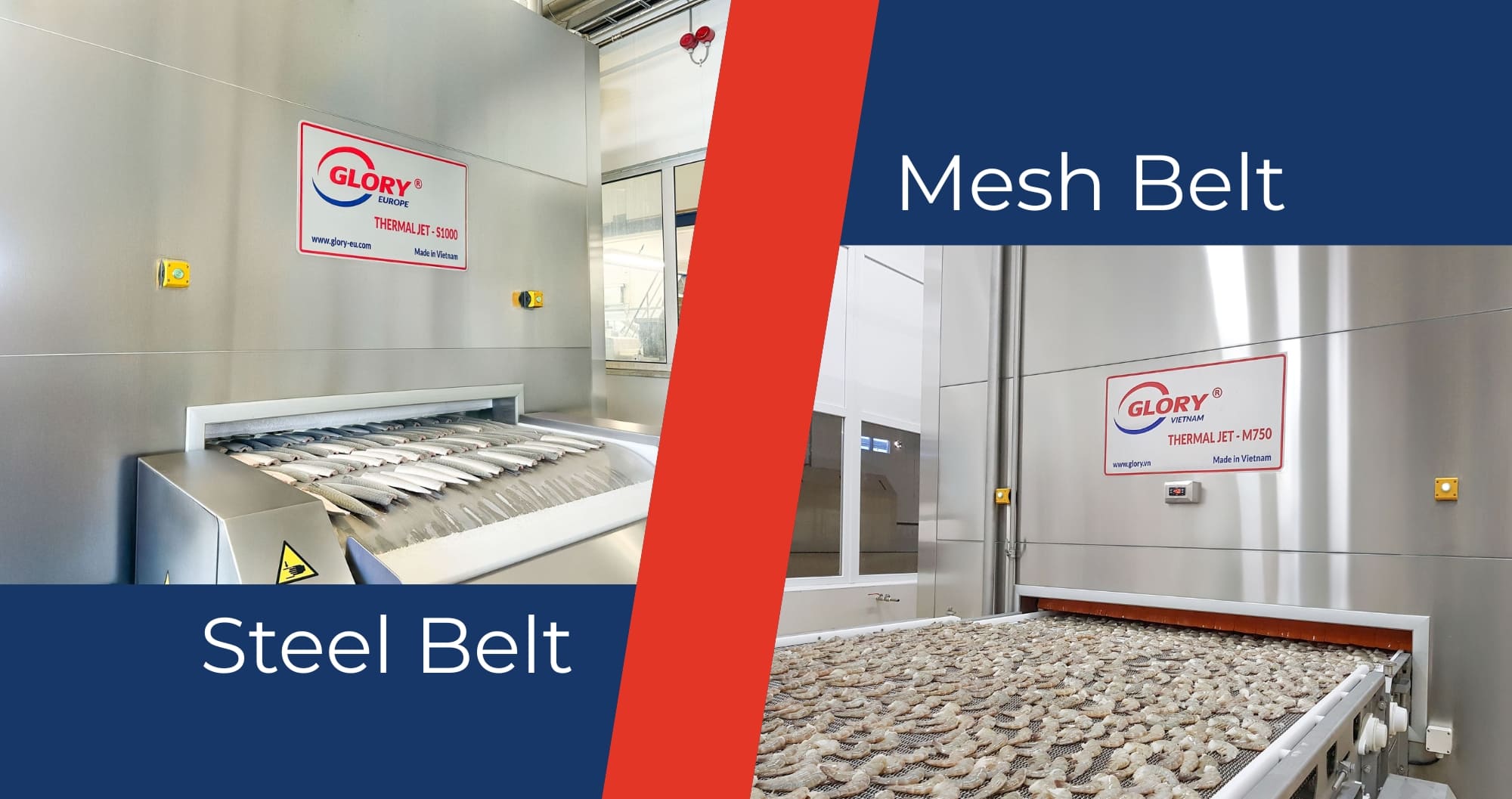
I/ Introduction: Why Belt Type Matters in IQF Freezing
When selecting an IQF freezer, most processors focus on capacity and freezing performance.
However, one of the most critical design decisions is often overlooked:
Steel belt or mesh belt?
The type of belt directly affects:
Product appearance
Hygiene level
Yield retention
Maintenance requirements
Long-term operating cost
This article compares steel belt IQF freezers vs mesh belt IQF freezers, helping processors choose the right solution for their specific application.
II/ Overview of Mesh Belt IQF Freezers
Mesh belt IQF systems use a perforated stainless-steel mesh conveyor that allows air to circulate through the product layer.
Key characteristics:
Strong airflow penetration
Good flexibility for various product types
Cost-effective design
Widely used in seafood processing
Common applications:
Shrimp (HOSO, HL, PDTO)
Small seafood
Vegetables
Value-added coated products
III/ Overview of Steel Belt IQF Freezers
Steel belt IQF systems use a solid, flat stainless-steel belt.
Key characteristics:
Smooth surface contact
Reduced belt marks
Improved hygiene access
Gentle handling of delicate products
Common applications:
Fish fillets
Soft seafood products
Marinated or glazed products
Premium retail items
IV/ Key Comparison: Steel Belt vs Mesh Belt IQF
1. Product Appearance
Mesh Belt IQF:
Air passes through mesh
Possible belt marks on soft products
Suitable for robust items
Steel Belt IQF:
Smooth surface
Minimal surface marks
Better for premium presentation
👉 Advantage: Steel Belt (for delicate products)
2. Hygiene and Cleaning
Mesh Belt:
More structural intersections
Harder to clean thoroughly
More potential debris retention points
Steel Belt:
Flat, open design
Easier access for cleaning
Fewer hidden areas
👉 Advantage: Steel Belt (higher hygienic design level)
3. Airflow and Freezing Efficiency
Mesh Belt:
Excellent airflow penetration
Efficient for small or irregular products
Strong freezing intensity
Steel Belt:
Airflow primarily from above and sides
Requires optimized airflow design
👉 Advantage: Mesh Belt (for high airflow penetration)
4. Product Separation and Clumping
Mesh Belt:
Effective for small products
Works well with fluidization
Steel Belt:
Better for flat or larger items
Reduced sticking to belt surface
Choice depends on product geometry.
5. Maintenance and Durability
Mesh Belt:
More moving joints
Higher wear potential
Replacement complexity
Steel Belt:
Simpler belt structure
Longer lifespan
Easier inspection
👉 Advantage: Steel Belt (long-term durability)
6. Cost Considerations
Mesh Belt IQF:
Lower initial investment
Simpler structure
Steel Belt IQF:
Higher upfront cost
Advanced hygienic and structural features
👉 CAPEX: Mesh Belt lower
👉 TCO (long-term): Depends on application and hygiene requirements
V/ When to Choose Mesh Belt IQF
Mesh belt IQF is suitable when:
Freezing small seafood or vegetables
Budget is limited
Product is robust
High airflow penetration is required
VI/ When to Choose Steel Belt IQF
Steel belt IQF is ideal when:
Product is delicate (fillets, soft seafood)
Premium appearance is critical
Hygiene standards are strict
Long-term maintenance cost is a concern
VII/ Decision Factors to Consider
Before choosing, evaluate:
Product type and geometry
Target market (bulk vs premium retail)
Hygiene requirements
Maintenance capability
Long-term cost strategy
Selecting the wrong belt type can impact:
Product rejection rate
収率
Cleaning downtime
運営コスト
VIII/結論
Both steel belt and mesh belt IQF freezers have their place in industrial freezing.
Mesh belt IQF offers flexibility and strong airflow performance for robust products.
Steel belt IQF delivers superior hygiene, reduced surface marking, and premium product presentation.
The best choice depends on your product, market, and long-term operational goals.
Choosing the right belt system ensures:
Consistent product quality
Controlled operating cost
Sustainable performance