
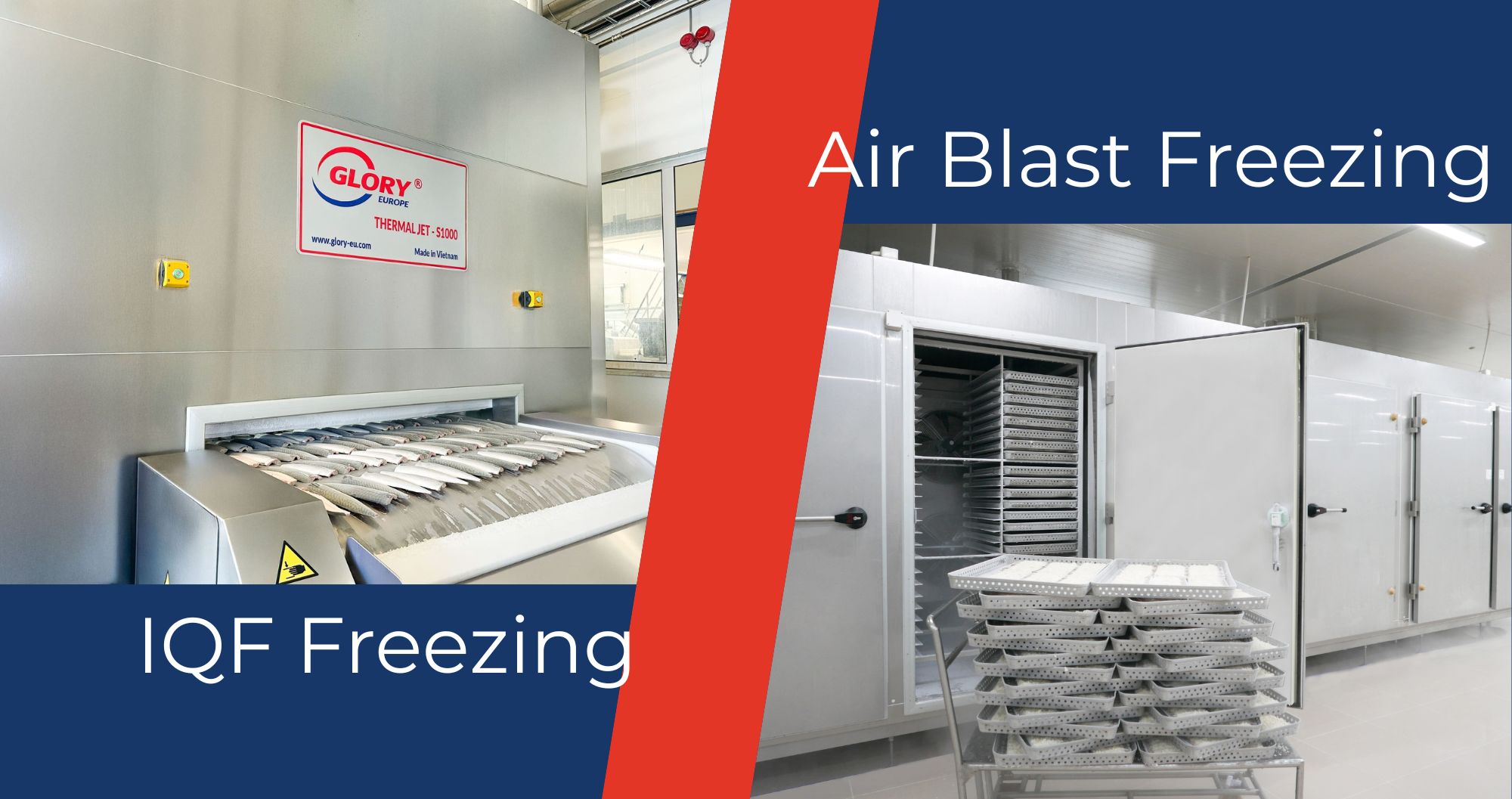
I/ Introduction: Why Freezing Method Matters in Seafood Processing
Seafood is among the most delicate food products to freeze.
High moisture content, fragile muscle fibers, and active enzymes make seafood extremely sensitive to freezing speed, dehydration, and mechanical handling.
Choosing the wrong freezing method can result in:
Yield loss
Poor texture after thawing
Product clumping
Reduced market value
Two of the most widely used freezing technologies today are IQF (Individual Quick Freezing) そして Air Blast Freezing.
While both are effective in specific scenarios, they deliver very different results.
This article compares IQF freezing vs air blast freezing for seafood, helping processors determine which solution best fits their production goals.
II/ Overview of IQF Freezing
IQF freezing (Individual Quick Freezing) is a continuous freezing process where each seafood piece is frozen 個別に迅速に using high-velocity cold air.
Key characteristics of IQF freezing:
Extremely fast freezing speed
Individual product separation
流動性の高い最終製品
Minimal ice crystal damage
IQF freezing is widely used for:
Shrimp (HOSO, HL, PDTO)
Fish fillets
Squid and octopus
Value-added seafood products
III/ Overview of Air Blast Freezing
Air blast freezing is a traditional batch freezing method where seafood products are placed in trays, racks, or cartons and frozen using circulated cold air.
Key characteristics of air blast freezing:
Slower freezing speed
Products often frozen in groups or blocks
Longer exposure to cold air
Simple system design
Air blast freezing is commonly used for:
Block frozen seafood
Carton-packed products
Low-value or bulk freezing applications
IV/ Key Differences Between IQF and Air Blast Freezing
1. Freezing Speed
IQF Freezing:
Very rapid heat removal
Short freezing time
Small ice crystal formation
Air Blast Freezing:
Slower freezing process
Larger ice crystals
Higher risk of cell damage
Impact on seafood:
Faster freezing preserves texture and structure, especially for shrimp and fillets.
2. Product Quality After Thawing
IQF Freezing:
Firmer texture
Lower drip loss
Better appearance
Air Blast Freezing:
Softer texture
Higher moisture loss
Inconsistent visual quality
3. Yield Retention & Freezing Loss
IQF Freezing:
Faster surface freezing reduces dehydration
Higher yield retention
Air Blast Freezing:
Longer exposure causes moisture evaporation
Greater freezing loss
For high-volume seafood processors, even 1–2% yield difference significantly impacts profitability.
4. Product Separation & Clumping
IQF Freezing:
Seafood frozen individually
Free-flowing products
Easy portioning and repacking
Air Blast Freezing:
Products often stick together
Manual separation required
破損リスクが高い
5. 運用上の柔軟性
IQF Freezing:
様々なサイズの製品に最適です
付加価値加工に対応
ガラス加工や再冷凍との容易な統合
Air Blast Freezing:
柔軟性に限界がある
主に固定包装形態に適しています
6. 衛生と食品安全
IQF Freezing:
連続運転向けに設計されています
清掃しやすい
現代の衛生基準へのより良い準拠
Air Blast Freezing:
バッチ処理は汚染リスクを高める
清掃による作業停止時間は長くなる可能性があります
V/IQFとエアブラスト冷凍:比較検討
| 基準 | IQF冷凍 | Air Blast Freezing |
|---|---|---|
| Freezing speed | 非常に速い | 遅い |
| 製品分離 | 個人 | グループ/ブロック |
| Yield retention | 高い | Moderate |
| 解凍後の食感 | Firm | Softer |
| Free-flowing product | Yes | No |
| 柔軟性 | 高い | 限定 |
| Best for | 高級シーフード | 大量冷凍 |
VI/ エアブラスト冷凍はどのような場合に有効なのか?
限界はあるものの、送風冷凍には依然として実用的な用途がある。
冷凍エビまたは魚のブロック
カートンに直接冷凍された製品
低コストの冷凍ソリューション
生産の複雑さは限定的である。
空気噴射冷凍は、 シンプルさと低い初期投資 これらが主な懸念事項です。
VII/ When IQF Freezing Is the Better Choice
IQF冷凍は、加工業者が以下のことを目指す場合に最適なソリューションです。
最高級のシーフード品質
最大収量保持率
Free-flowing products
付加価値加工
長期的な業務効率
輸出志向のシーフード加工業者にとって、IQF冷凍はしばしば 市場の期待に応えるために不可欠.
VIII/ 考慮すべき重要な制限事項
IQF冷凍は万能薬ではない。
原材料の品質不良は改善できません
黒点病対策には、適切な前処理が依然として必要です。
オペレーターのスキルとプロセス管理は依然として重要である。
魚介類の冷凍保存の成功は、 処理チェーン全体, not the freezer alone.
IX/結論
IQF冷凍とエアブラスト冷凍はどちらもシーフード加工において重要な役割を果たしますが、 異なる生産目標.
Air blast freezing シンプルで低コストな大量冷凍に適しています。
IQF freezing 優れた品質、高い収量、そして高い柔軟性を実現し、現代のシーフード加工業者にとって最適な選択肢となっています。
これらの違いを理解することで、加工業者は適切な冷凍技術を選択できるようになります。 品質、効率、収益性を最大化する.