

 English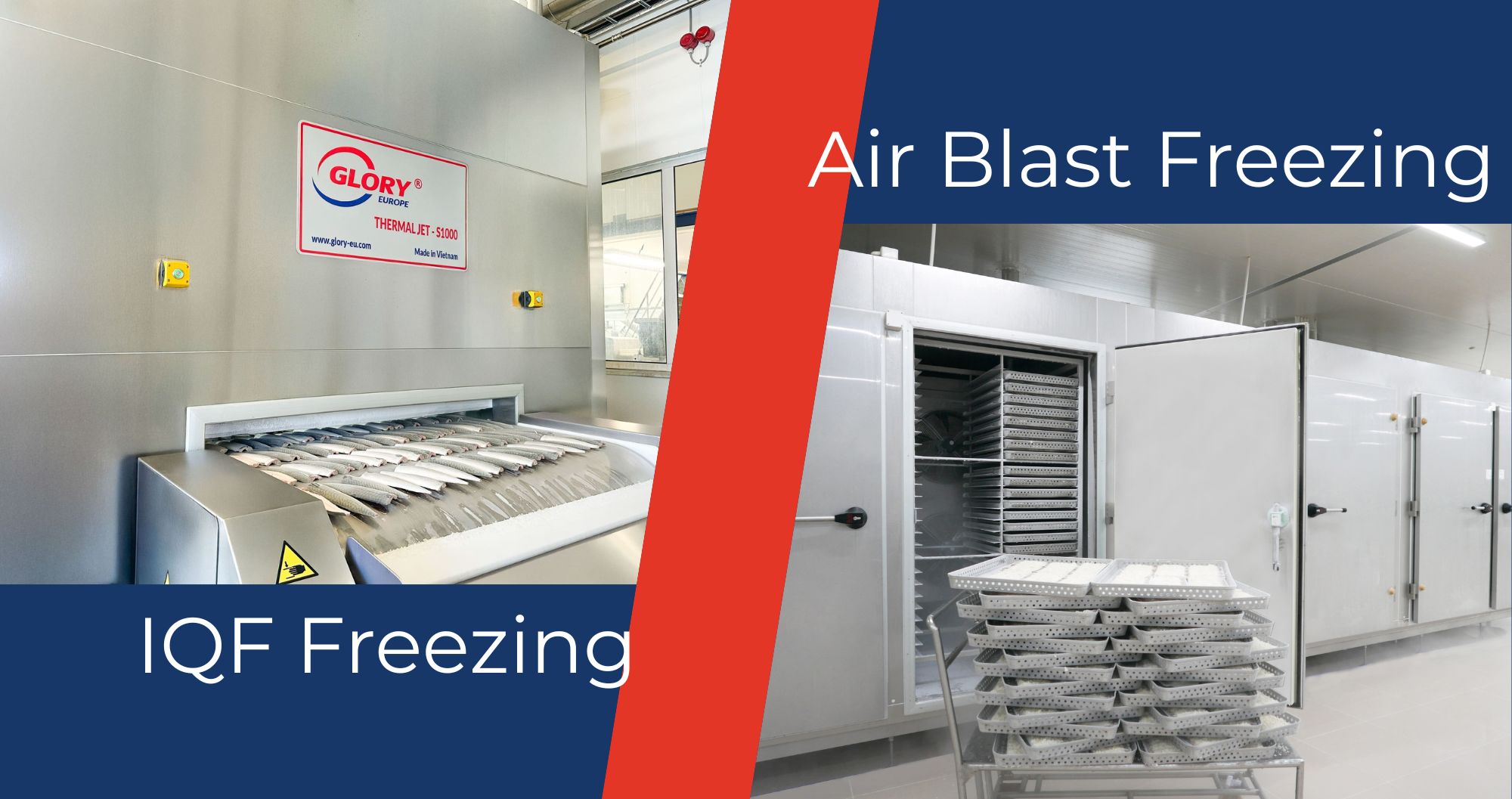
I/ Introduction: Why Freezing Method Matters in Seafood Processing
Seafood is among the most delicate food products to freeze.
High moisture content, fragile muscle fibers, and active enzymes make seafood extremely sensitive to freezing speed, dehydration, and mechanical handling.
Choosing the wrong freezing method can result in:
Yield loss
Poor texture after thawing
Product clumping
Reduced market value
Two of the most widely used freezing technologies today are IQF (Individual Quick Freezing) and Air Blast Freezing.
While both are effective in specific scenarios, they deliver very different results.
This article compares IQF freezing vs air blast freezing for seafood, helping processors determine which solution best fits their production goals.
II/ Overview of IQF Freezing
IQF freezing (Individual Quick Freezing) is a continuous freezing process where each seafood piece is frozen individually and rapidly using high-velocity cold air.
Key characteristics of IQF freezing:
Extremely fast freezing speed
Individual product separation
Free-flowing final products
Minimal ice crystal damage
IQF freezing is widely used for:
Shrimp (HOSO, HL, PDTO)
Fish fillets
Squid and octopus
Value-added seafood products
III/ Overview of Air Blast Freezing
Air blast freezing is a traditional batch freezing method where seafood products are placed in trays, racks, or cartons and frozen using circulated cold air.
Key characteristics of air blast freezing:
Slower freezing speed
Products often frozen in groups or blocks
Longer exposure to cold air
Simple system design
Air blast freezing is commonly used for:
Block frozen seafood
Carton-packed products
Low-value or bulk freezing applications
IV/ Key Differences Between IQF and Air Blast Freezing
1. Freezing Speed
IQF Freezing:
Very rapid heat removal
Short freezing time
Small ice crystal formation
Air Blast Freezing:
Slower freezing process
Larger ice crystals
Higher risk of cell damage
Impact on seafood:
Faster freezing preserves texture and structure, especially for shrimp and fillets.
2. Product Quality After Thawing
IQF Freezing:
Firmer texture
Lower drip loss
Better appearance
Air Blast Freezing:
Softer texture
Higher moisture loss
Inconsistent visual quality
3. Yield Retention & Freezing Loss
IQF Freezing:
Faster surface freezing reduces dehydration
Higher yield retention
Air Blast Freezing:
Longer exposure causes moisture evaporation
Greater freezing loss
For high-volume seafood processors, even 1–2% yield difference significantly impacts profitability.
4. Product Separation & Clumping
IQF Freezing:
Seafood frozen individually
Free-flowing products
Easy portioning and repacking
Air Blast Freezing:
Products often stick together
Manual separation required
Higher risk of breakage
5. Operational Flexibility
IQF Freezing:
Ideal for mixed product sizes
Supports value-added processing
Easy integration with glazing and re-freezing
Air Blast Freezing:
Limited flexibility
Mainly suited for fixed packaging formats
6. Hygiene & Food Safety
IQF Freezing:
Designed for continuous operation
Easier cleaning access
Better compliance with modern hygiene standards
Air Blast Freezing:
Batch handling increases contamination risk
Cleaning downtime can be longer
V/ IQF vs Air Blast Freezing: Side-by-Side Comparison
| Criteria | IQF Freezing | Air Blast Freezing |
|---|---|---|
| Freezing speed | Very fast | Slow |
| Product separation | Individual | Group / block |
| Yield retention | High | Moderate |
| Texture after thawing | Firm | Softer |
| Free-flowing product | Yes | No |
| Flexibility | High | Limited |
| Best for | Premium seafood | Bulk freezing |
VI/ When Does Air Blast Freezing Still Make Sense?
Despite its limitations, air blast freezing still has practical applications:
Block frozen shrimp or fish
Products frozen directly in cartons
Low-cost freezing solutions
Limited production complexity
Air blast freezing remains a viable option when simplicity and lower initial investment are the primary concerns.
VII/ When IQF Freezing Is the Better Choice
IQF freezing is the preferred solution when processors aim for:
Premium seafood quality
Maximum yield retention
Free-flowing products
Value-added processing
Long-term operational efficiency
For export-oriented seafood processors, IQF freezing is often essential to meet market expectations.
VIII/ Important Limitations to Consider
IQF freezing is not a miracle solution:
It cannot fix poor raw material quality
Black spot control still requires proper pre-treatment
Operator skill and process control remain critical
Successful seafood freezing depends on the entire processing chain, not the freezer alone.
IX/ Conclusion
Both IQF freezing and air blast freezing play important roles in seafood processing—but they serve different production goals.
Air blast freezing is suitable for simple, low-cost, bulk freezing.
IQF freezing delivers superior quality, higher yield, and greater flexibility, making it the preferred choice for modern seafood processors.
Understanding these differences allows processors to select the right freezing technology to maximize quality, efficiency, and profitability.